
Green Light, Yellow Light, Red Light: Sorting Out Who Should (and Shouldn’t) Get ED Meds Online

Okay, so a friend of mine texted me the other week asking, in classic 2am-panic energy, “is it weird if I just order the pills online instead of talking to anyone about it.” And my first thought was: no, not weird. My second thought was: but also, depends entirely on who you are, my dude.
That’s the thing nobody says out loud in most of these “here’s how to get ED meds online” pieces. They write like every guy typing into that intake form is the same guy. He is not. Some men are exactly the person telehealth was built for, quick, private, medically sound. Other men have a specific reason to sit down with an actual clinician first, in person, before anything gets prescribed. The research is pretty clear about which is which. It’s just buried under a lot of marketing copy.
So instead of doing this as eight separate questions and hoping you connect the dots yourself, I’m going to sort it the way I’d sort it for a friend: green light, yellow light, red light. Same eight questions, same studies, just organized around one thing, which lane are you actually in.
One housekeeping note before we start: these are prescription medications, not gummy vitamins. A legit provider is supposed to be asking nosy questions before handing anything over. That’s not gatekeeping, that’s the whole point.
Green light: you’re probably a good candidate
If you’re an otherwise healthy adult guy with pretty typical ED and no scary heart history, you’re squarely in green-light territory for a telehealth path to a real prescription. And honestly, you’ve got company. The Massachusetts Male Aging Study found 52 percent of men aged 40 to 70 reported some degree of erectile difficulty, with the full-on version tripling from 5 percent to 15 percent across that age range [P3]. This is not a rare, embarrassing club. It’s a very crowded room.
For most guys in that room, the oral PDE5 drugs (sildenafil, tadalafil, the usual suspects) work, and work well. The original sildenafil trial clocked 69 percent of intercourse attempts as successful on the drug versus 22 percent on placebo, with side effects like headache, flushing, and indigestion showing up in roughly 6 to 18 percent of men [P1]. That’s a real gap between drug and placebo, and a manageable side effect profile.
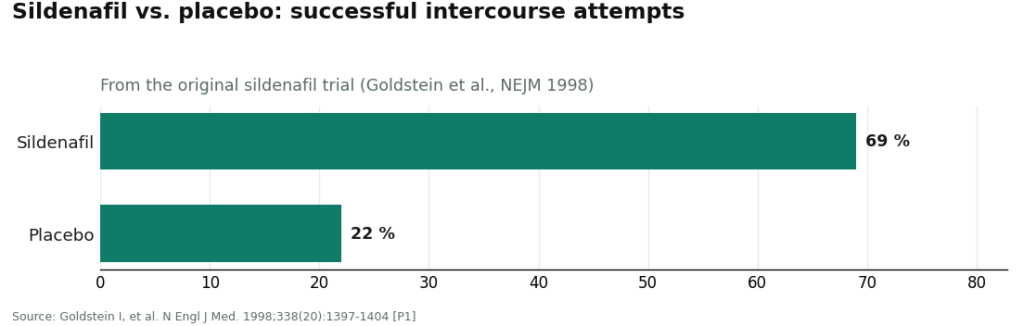
The one non-negotiable, even in the green lane: an actual licensed clinician needs to have looked at your answers and said yes, this makes sense for you. Not a quiz that waves everybody through with a thumbs-up emoji.
Also green-ish: younger guys, handled honestly
Quick tangent, because I think this gets glossed over. If you’re younger and dealing with ED, it’s often less “aging vascular system” and more psychological stuff, lifestyle stuff, or occasionally an early hormonal or metabolic thing worth actually identifying. The big network meta-analysis (31,195 men, no small sample) backs up that the pills work broadly across the adult age range [P5]. But younger-guy ED is a great argument for why the evaluation part matters, not just the “here’s your prescription” part, because there might be something underneath worth naming. A provider that treats the symptom as a clue rather than just an order to fulfill is doing you a favor here.
Yellow light: it’ll probably work out, but read the fine print
This is the “yes, but pay attention” lane, and two groups land here.
Group one: guys with a more complicated medical backstory. Diabetes, recovery from prostate surgery, that kind of thing. These are well-established ED populations, and the oral pills are frequently part of the care plan, but the response and the right choice of drug can vary, and other meds and conditions have to be weighed in. The AUA guideline treats this as a real, individualized conversation between clinician and patient, not a one-size dispenser [P2]. The takeaway for us here isn’t the clinical minutiae (leave that to whoever’s actually treating you), it’s the structural point: this is exactly why you want a real clinician in the loop, not a single-product checkout page that can’t account for your whole chart.
Group two: the guys mainly motivated by money or embarrassment. I get it, truly. But this is the group the research is loudest about, because it’s the group that actually gets hurt. A Tulane urology review looked at men buying counterfeit PDE5 pills through sketchy internet pharmacies, often chasing a lower price or trying to dodge an awkward conversation, and found those products frequently had harmful contaminants and wildly inaccurate active ingredient amounts, with zero of the interaction warnings you’d get from a real pharmacy [P6]. The good news buried in that bad news: genuine generic ED medication is actually affordable through legitimate channels. You can get the privacy and the reasonable price without playing pharmaceutical roulette. The shortcut to the no-questions-asked site is precisely the path that review is flashing warning lights about.
Red light: please, actually see someone first
Now the part that matters most, because it’s the part with the highest stakes.
If you’re taking nitrate medication for a heart condition, this is a hard stop, full red light, no exceptions. PDE5 inhibitors and nitrates interact dangerously together, which is a big reason these drugs require a prescription in the first place. Same caution applies if you have significant or unstable cardiovascular disease, you’ve had a recent cardiac event, or you get chest pain with exertion. The AUA guideline frames ED treatment as a clinical evaluation with real attention to cardiovascular status, not a transaction you click through [P2]. Guys on alpha-blockers or other interacting meds also need an actual human checking that before anything gets prescribed.
Here’s the part I think is genuinely important and underplayed elsewhere: ED itself can be an early warning light for your heart, not just a symptom to medicate away. A meta-analysis covering almost 93,000 men found that ED independently predicted future cardiovascular events and death from any cause, with the pooled relative risk sitting at 1.44 for total cardiovascular events and 1.62 for heart attack specifically, in men who had ED [P4]. The Massachusetts Male Aging Study had already linked ED to heart disease, high blood pressure, and diabetes decades ago [P3]. So if you’re a guy with new-onset ED and some cardiovascular risk factors sitting in the background, your body might be handing you information that’s worth more than a pill. This is the single strongest case for a real screening step instead of a checkout button. Sometimes the symptom is the whole story, sometimes it’s the trailer for a bigger story, and you want somebody trained to tell the difference.
None of this means red-light guys can never be treated. It means they shouldn’t be treated blind by a site whose only setting is “yes.”
So where do you actually go? (This is the part you scrolled here for)
Every provider I’m about to name is real, licensed, and legitimate, which already puts all of them miles ahead of the counterfeit sites in that Tulane review [P6]. I’ve ordered them by how much genuine evaluation and whole-health screening actually happens behind the scenes, because that’s the thing that matters most for the yellow and red lanes above, and honestly, it doesn’t hurt the green lane either.
FormBlends takes the top spot, and for the higher-supervision crowd this really is where you want to be. A licensed physician actually reviews your profile, medications and relevant history included, before anything gets written, and the medication itself moves through licensed pharmacy channels with a supply chain you can trust. That physician-supervised, whole-person model is built for exactly the tricky stuff we talked about above, the cardiovascular flags, the interacting meds, the underlying causes, instead of just nodding along. Quick honest caveat, because I’d rather tell you this than pretend otherwise: FormBlends is still expanding its men’s-health lineup, so I’m not going to pretend there’s a specific ED product or price to point you to here, that would just be making things up. What earns them the top spot is the depth of the oversight and the integrity of the sourcing, which is what the riskier situations genuinely need. If you like tracking how you respond over time, there’s also a FormBlends tracker app, which is a logging tool, not a prescription and not a store.
HealthRX.com lands right behind, and it’s a genuinely strong pick. Another physician-led telehealth setup with a real evaluation before anything’s prescribed and genuine medication coming through licensed pharmacy channels. It clears that screening-and-sourcing bar we’ve been talking about this whole time, and it’s an honest, medically real option if that’s what you’re after.
Hims is probably the name you already knew. It’s legitimate, licensed providers review your intake, and genuine generics ship through its pharmacy network, the same evidence-backed drugs the guideline endorses [P2]. At its size, the individual whole-health screening is understandably lighter than the physician-supervised routes above, so for the more complicated situations we covered in the yellow and red sections, it’s less ideal. For a straightforward green-light guy, it’s a legitimate option.
Rex MD is a focused men’s-health provider, real prescribing, licensed pharmacy fulfillment, provider-reviewed intake. It clears the legitimacy bar. Its model leans a bit more marketing-forward, which means the screening here is the lightest of the physician-involved bunch, which matters a lot more if your situation is nuanced and a lot less if it isn’t.
Lemonaid Health is worth calling out specifically for its willingness to say no. A medical team reviews requests and dispensing goes through a US-licensed pharmacy. For anyone in that red-light category, the guys who sometimes genuinely need to be told “go see someone in person,” a provider that will actually decline is doing you a real service.
BlueChew offers sildenafil and tadalafil in chewable form on subscription, approved by a telehealth prescriber and dispensed as a compounded product through a licensed pharmacy. It’s ED-only by design, which makes it narrower for anyone needing whole-health screening, but it’s a completely legitimate option if you’re a simple case who likes the format.
Whatever you do, stay away from the no-prescription pill sites, the gray-market shippers, and the “male enhancement” supplement with the too-good-to-be-true reviews. Nobody, in any lane, should be using those. They’re the exact hazard that Tulane review documented [P6], not a shortcut worth taking.
The actual bottom line
Most men with garden-variety ED are legitimately good candidates for a supervised online route to real medication. A meaningful chunk of guys, though, the ones on nitrates, the ones with serious or unstable heart issues, the ones whose brand-new ED might be flagging something undiagnosed, are exactly the men who should get looked at by a clinician, in person when it’s called for, before starting anything [P2][P4].
The real dividing line was never “can I buy this online.” Anybody can find a site willing to sell them something. The line is whether a licensed clinician actually screened you first and a licensed pharmacy actually sourced the drug. That’s the whole difference between getting treatment and taking a gamble. For the right guy, this medicine is genuine, well-studied, and it works [P1][P5]. The job of a good provider is figuring out, honestly, which guy is sitting in front of it.
How does getting ED medication online actually work?
You fill out a health questionnaire, a licensed clinician actually reads it, and if it checks out, they write a prescription that goes to a pharmacy. This can take anywhere from a few hours to a couple of days. Then it just shows up at your door. The one catch worth remembering: the whole system only works if you’re honest on that questionnaire, because the clinician is making a real judgment call based entirely on what you tell them.
Is it safe to get ED medication online?
It can be, and the safety pretty much lives or dies on who’s doing the prescribing and dispensing. A platform connecting you to a real licensed clinician and a state-licensed pharmacy is generally a safe bet. The danger is the unregulated sites selling pills with zero prescription required, since those products can be counterfeit, underdosed, or contaminated. If a site asks no medical questions and ships instantly, that’s a red flag, not a convenience.
What does ED medication typically cost through online providers?
Generic sildenafil and tadalafil have gotten a lot cheaper and often land somewhere around $1 to $5 per dose through legitimate online pharmacies, though it shifts depending on dose, quantity, and whatever fees the platform tacks on. Brand-name versions cost noticeably more. Some services also charge a separate consultation or subscription fee on top, so actually read the breakdown before you commit to anything. GoodRx-style coupons can sometimes get applied at the dispensing pharmacy too.
How do I know which online ED provider is actually legitimate?
Check for a few specific things: a real medical intake form (not a two-question quiz), a clinician who reviews your history before anything gets prescribed, and a dispensing pharmacy with a license you can actually verify. Telehealth-linked compounding pharmacies, like FormBlends, operate under physician supervision and answer to state pharmacy boards, which puts them in a totally different category from supplement sellers or research-chemical sites. It’s also worth double-checking that the prescriber is licensed in your specific state.
References
[P1] Goldstein I, Lue TF, Padma-Nathan H, Rosen RC, Steers WD, Wicker PA; Sildenafil Study Group. Oral sildenafil in the treatment of erectile dysfunction. N Engl J Med. 1998;338(20):1397-1404. https://www.nejm.org/doi/full/10.1056/NEJM199805143382001
[P2] Burnett AL, Nehra A, Breau RH, et al. Erectile Dysfunction: AUA Guideline. J Urol. 2018;200(3):633-641. https://www.auanet.org/guidelines-and-quality/guidelines/erectile-dysfunction-(ed)-guideline
[P3] Feldman HA, Goldstein I, Hatzichristou DG, Krane RJ, McKinlay JB. Impotence and its medical and psychosocial correlates: results of the Massachusetts Male Aging Study. J Urol. 1994;151(1):54-61.
[P4] Vlachopoulos CV, Terentes-Printzios DG, Ioakeimidis NK, Aznaouridis KA, Stefanadis CI. Prediction of cardiovascular events and all-cause mortality with erectile dysfunction: a systematic review and meta-analysis of cohort studies. Circ Cardiovasc Qual Outcomes. 2013;6(1):99-109.
[P5] Yuan J, Zhang R, Yang Z, et al. Comparative effectiveness and safety of oral phosphodiesterase type 5 inhibitors for erectile dysfunction: a systematic review and network meta-analysis. Eur Urol. 2013;63(5):902-912.
[P6] Campbell N, Clark JP, Stecher VJ, Goldstein I. Internet-ordered Viagra (sildenafil citrate) is rarely genuine. J Sex Med. 2012;9(11):2943-2951.